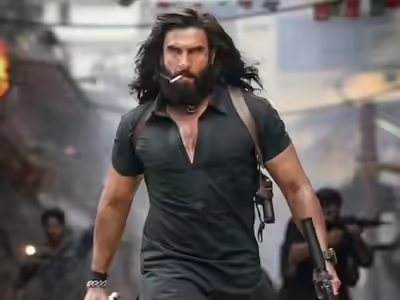
Since December 2025, Indians and even many non-Indians have been in a tizzy. Most of us have caught the Dhurandhar fever.
The first part released on 5th December ’25, and the second on 19th March ’26. With a combined runtime of nearly 7.5 hours, the format leans toward a web series. But this story deserved the big screen. And judging by the craze, people would have gladly sat through an 8-hour marathon.
Written, directed, and produced by Aditya Dhar, Dhurandhar follows an Indian spy who infiltrates a gang in Lyari, Karachi, to stop the bleeding in India.
For decades, India has faced terrorism, unrest, and conflict. What is often described as “bleeding India with a thousand cuts” is not just a phrase. It reflects a reality many have lived through.
History carries both pride and pain. The 1971 war led to Bangladesh’s liberation. The tensions that followed never truly faded.
For me, this story is deeply personal. I was born and brought up in Mumbai. It is a city that has endured repeated attacks. Blasts in commercial areas, local trains, and the darkest of them all, 26/11, when the city was under siege for days. These are not just events. They are memories. Many families have lost loved ones. Soldiers and civilians alike. Lives taken without warning and without reason.
That is why Dhurandhar does not feel like just a film. It becomes a reflection of pain, resilience, and the longing for justice. As the narrative moves from chaos to justice, revenge does not feel loud or cinematic. It feels quiet, heavy, and deeply human. It feels like a long-awaited answer to years of grief.
The performances are raw and grounded. They are not larger-than-life heroes. They are flawed, determined individuals. You do not just watch them. You feel them.
Technically, the film may not be perfect, but it is sincere. Every department works together to create an immersive experience: writing, direction, cinematography, and music. Aditya Dhar commands the story behind the scenes. Ranveer Singh brings intensity and presence on screen.
And the music deserves special mention. At a time when Hindi film music often feels forgettable, Dhurandhar brings back emotion. The background score becomes the film’s pulse. The nostalgic 90s remixes are used thoughtfully. The original tracks feel like anthems that stay with you long after.
Some films do not just entertain you. They stay with you, unsettle you, and make you reflect. Dhurandhar is one of them. It does not just tell a story. It brings you face to face with a reality that has shaped countless lives: the pain, the fear, and the quiet strength to endure.
And for those who call it propaganda, perhaps it is worth reflecting on what feels uncomfortable, especially to those who have lived these moments directly or closely. Because for many of us, this is not just cinema. It is memory. It is emotion. It is personal.
Thank you, Aditya Dhar and the entire team of Dhurandhar, for telling a story that resonates so deeply.